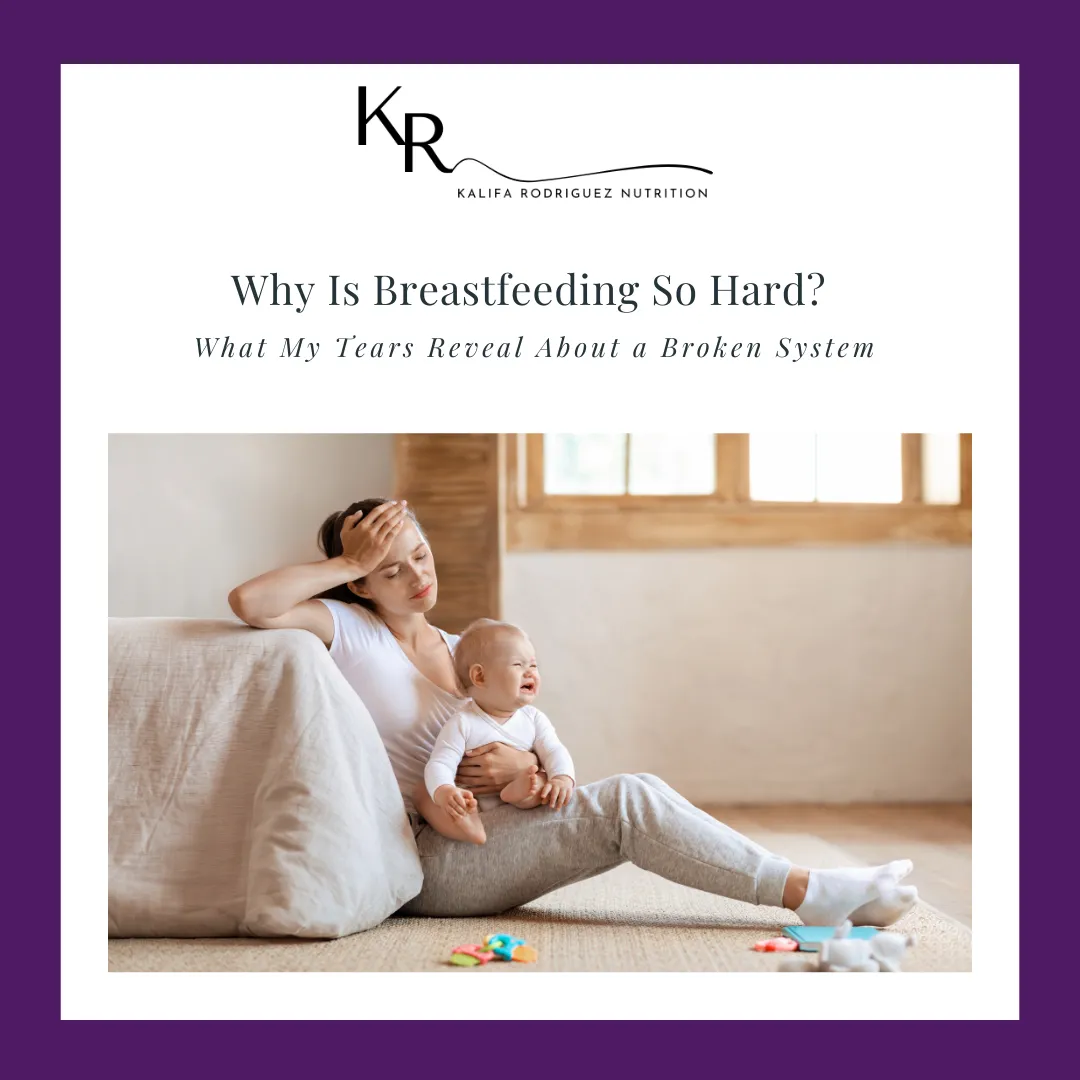
Why Is Breastfeeding So Hard? What My Tears Reveal About a Broken System
As said by a very wise person, "where there's a will, there's a way.”
- Kalifa Rodriguez, Founder
I remember sitting on the edge of my bed, tears streaming down my face, my newborn finally asleep on my chest. My body ached as I glared at the breast pump across the room. In the silence of the night my mind was loud with one relentless question:
Why does something that’s supposed to be natural feel this hard?
I wasn’t uneducated. I wasn’t lazy. I wasn’t unmotivated. I was a registered dietitian. I had read the research and I wanted this. And yet, in that moment, I felt defeated, confused, and deeply alone.
That moment didn’t break me.
It opened my eyes.
Because when breastfeeding feels impossible for someone who has the knowledge, the support-seeking skills, and the desire, the issue is not the mother.
The issue is the system.

Breastfeeding rates tell a story and it’s not the one we like to tell
In both Canada and the United States, breastfeeding starts strong and then quietly collapses.
Most mothers do initiate breastfeeding. They want to do it. They believe in its benefits. But as the days and weeks pass, motivation thins out, confidence erodes, and real life takes over.
By six months, exclusive breastfeeding rates drop dramatically in both countries. By one year, many moms feel like they “couldn’t make it,” even though what really happened is that they weren’t supported well enough to learn how.
This pattern matters. Not because breastfeeding is morally superior, but because it reflects how we treat mothers during one of the most vulnerable transitions of their lives.
We praise breastfeeding loudly.
Then we abandon moms quietly.
The things that no one prepares you for
1. We confuse “natural” with “instinctive”
Breastfeeding is biological.
It is not automatic.
No one expects childbirth to happen without education, preparation, or support. Yet breastfeeding is often treated like a reflex. As if milk should just flow, babies should just latch, and discomfort should magically resolve on its own.
Most moms are never taught:
What an effective latch actually looks like
How often newborns are supposed to feed
How to distinguish low supply from normal cluster feeding patterns
What nipple pain is common vs a red flag
How maternal nutrition, stress, and recovery affect milk production
So when these challenges show up, they don’t feel like challenges, it is mistaken as personal failure.
2. Support exists, but it’s fragmented and inconsistent
Many parents receive rushed hospital support, conflicting advice, or no follow-up at all once they’re home. Lactation care may be unavailable, unaffordable, or inaccessible when it’s actually needed.
Imagine this, my daughter spent the 1st 2 months of her life in the NICU and experienced various feeding difficulties requiring enteral nutrition, as she was too physically small and weak to latch. I had delayed milk production. During that time, I had a total of 2 visits from the lactation consultant on staff. The nurses where somewhat helpful…depending on who it was…while others I blame for the reason why daughter developed a feeding aversion in the 1st place. For me formula was not an option as long as I could produce the milk she needed (which wasn’t very much given her small size). That being said, it took me 3 months before I finally had my 1st appointment with a lactation consultant after a doctor had finally listened to my concerns and referred me to an outpatient clinic…by this time my milk supply and moral was hanging by a thread.
Breastfeeding is time-sensitive.
Waiting days or weeks for help can mean lost supply, escalating pain, or emotional shutdown.
When support arrives too late, formula becomes the emergency exit. Not because moms didn’t want to breastfeed, but because they needed relief.
3. Work and breastfeeding are still in conflict
Breastfeeding does not end when maternity leave does.
Returning to work without protected pumping time, private spaces, or schedule flexibility forces many parents into an impossible choice. Even when laws exist, awareness and enforcement lag behind.
Milk supply is not resilient to chronic stress, skipped pumps, or exhaustion. When work environments are not breastfeeding-friendly, supply often suffers first.
The disparity we cannot ignore: Why Black women breastfeed at lower rates
In case you didn’t know, breastfeeding challenges are not evenly distributed.
In the United States, Black women consistently have lower breastfeeding initiation and duration rates compared to other groups. This gap is not about desire. Surveys repeatedly show that Black mothers want to breastfeed at similar rates.
The difference lies in conditions, not commitment.
Key contributors include:
Reduced access to culturally safe lactation support
Higher likelihood of returning to work earlier in inflexible jobs
Medical bias and dismissal of concerns
Lack of representation in breastfeeding education and imagery
Generational trauma linked to the history of wet nursing and bodily exploitation
When a mother does not feel seen, believed, or supported, breastfeeding becomes impossible.
Canada faces a different challenge. While breastfeeding rates are tracked nationally, race-based data is still inconsistently collected across provinces. This makes it harder to truly quantify disparities, but community-level observations and research suggest that racialized mothers also face access and support gaps.
You cannot fix what you refuse to measure.
You cannot close gaps you refuse to name.

What’s changing: A 2026 recap of real solutions taking shape
The good news? This conversation is shifting.
1. Breastfeeding is finally being treated as a public health issue, not a personal hobby.
Hospitals and health systems are increasingly aligning with evidence-based breastfeeding standards that prioritize early, consistent, and non-judgmental support. The focus is slowly moving from “Did you try?” to “Did you have support?”
2. Virtual lactation care is expanding access
Telelhealth has been one of the most impactful changes in recent years. Being able to receive professional guidance in real time, from your own home, reduces barriers related to transportation, childcare, and timing.
This model has shown promise in supporting underserved communities and reducing disparities by meeting parents where they are.
This same principle is why I created Energize & Nurture: A Nutrition Guide for Breastfeeding Mothers. A self-paced course that gives pregnant and postpartum moms immediate access to evidence-based guidance, without referrals, wait times, or travel.
3. Community-led and culturally grounded support is gaining momentum
Peer counselors, community doulas, and culturally specific breastfeeding initiatives are reshaping how support looks. These models recognize that trust matters as much as technique.
When moms see themselves reflected in the support they receive, outcomes improve.
4. Nutrition and lactation are being reunited
For too long, breastfeeding has been treated as separate from maternal nutrition, recovery, and mental health.
The 2026 shift is more holistic. Supporting milk supply now increasingly includes:
Adequate energy and protein intake
Micronutrient sufficiency
Stress regulation
Sleep and recovery support
Mental health screening and care
What mothers actually need and deserve
If we want breastfeeding rates to rise, we must stop asking moms to try harder and start building systems that hold them better.
That means:
Honest prenatal education that prepares, not idealizes
Early postpartum support before problems spiral
Accessible lactation care, including virtual options
Workplace policies that protect pumping without penalty
Culturally safe, respectful care for Black and racialized mothers
Integrated nutrition and lactation support that treats moms as whole people
Breastfeeding success is not about willpower.
It is about infrastructure.
Breastfeeding outcomes are not just about infant feeding choices. They are linked to maternal mental health, healthcare costs, workforce participation, and long-term health equity. When systems fail breastfeeding mothers, the ripple effects extend far beyond the postpartum period.
Why I do this work
That moment on my bed, crying and questioning myself, changed the trajectory of my life.
It showed me that even knowledgeable, motivated mothers can struggle in silence. If that was true for me, it was certainly true for thousands of others.
I don’t believe breastfeeding is mandatory, but I believe every mother deserves informed choice, real support, and the chance to succeed.
If breastfeeding feels hard, you are not broken.
You are responding to a system that was never designed to fully support you.
Breastfeeding should never be a test of endurance or worth. When it becomes one, it’s time to stop asking mothers to do more and start asking systems to do better.
Until those systems are in place, mothers will continue to carry a burden that was never meant to be theirs alone.
If you happen to be reading this after shedding a few tears yourself, and are looking for guidance that supports your body, your milk supply, and your confidence, I’m always here.