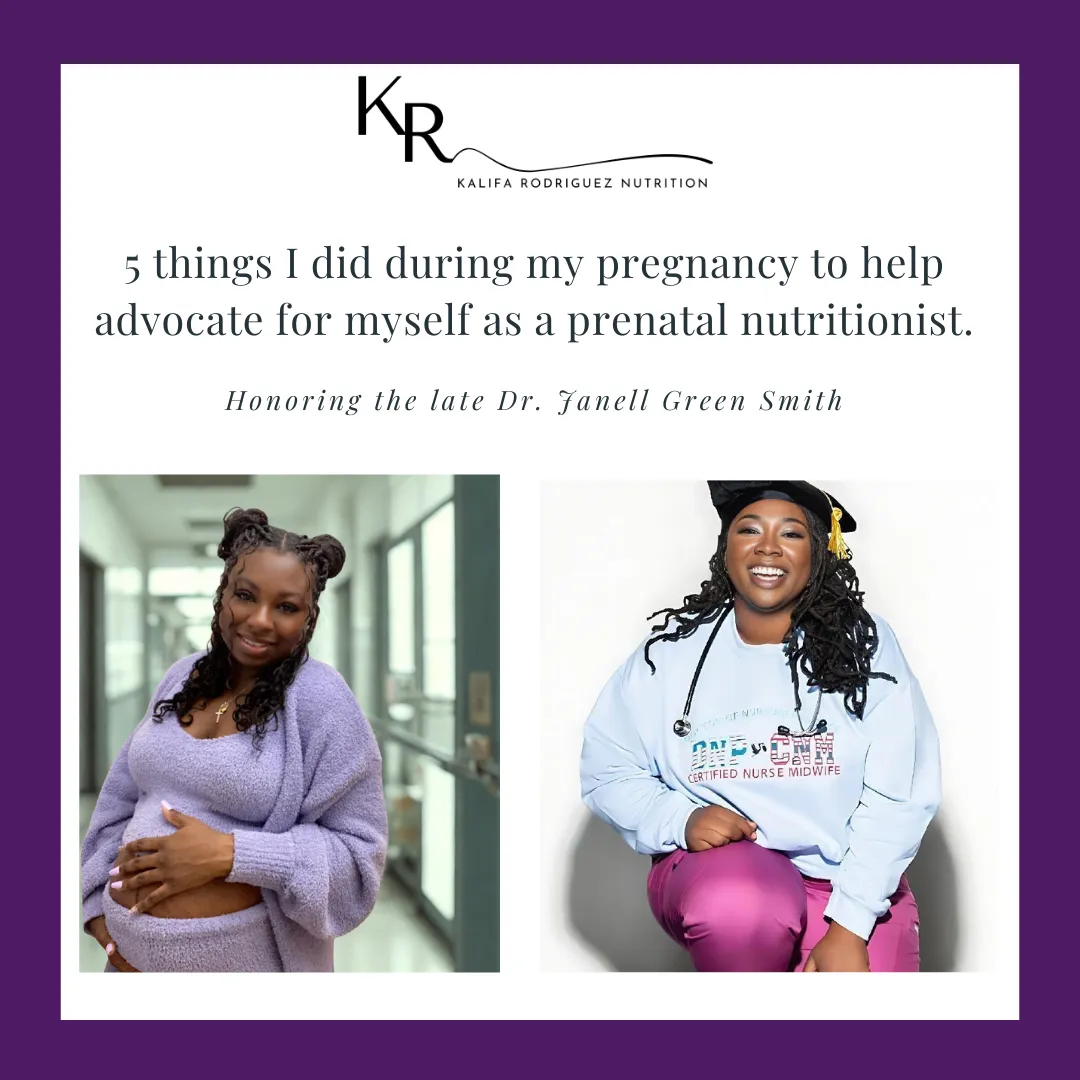
Honoring Dr. Janell Green Smith and the Self-Advocacy That Saved My Peace During Pregnancy
“Advocacy is a muscle. It gets stronger every time we choose not to be dismissed. Advocacy is lifesaving work. Dr. Janell Green Smith showed us that protecting Black mothers is not optional. It is essential”
- Kalifa Rodriguez, Founder
The tragic passing of Dr. Janell Green Smith shook the maternal health community. It shook Black women deeply. She was a midwife. An advocate. A protector. A voice that refused to be quiet when Black mothers were dismissed, minimized, or endangered. Her work reminded us of a hard truth. Survival in pregnancy should not depend on how loud you can shout or how educated you are. And yet, too often, it still does.
I am a Registered Dietitian. A Certified Breastfeeding Specialist. A prenatal nutritionist. I am also a Black mother who has navigated a complicated pregnancy and postpartum journey. I carry the grief of knowing that advocacy is still required. I also carry the responsibility to share what helped me feel safer, stronger, and more seen while pregnant. This post is written in honor of Dr. Green Smith and for every Black mother who deserves better care, not braver endurance.

5 things I did during my pregnancy to help advocate for myself as a prenatal nutritionist.
1. I built my care team early. And I chose alignment over convenience.
I did not wait until something went wrong to assemble support. I chose providers who listened without rushing. Who explained instead of dismissed. Who respected my intuition as data, not drama. This meant asking hard questions early. It meant switching providers when my concerns were minimized. It meant choosing collaboration over hierarchy.
As a prenatal nutritionist, I know outcomes improve when care is proactive. Black women are often told to wait. Wait for labs. Wait for symptoms. Wait until postpartum. I refused to wait. Advocacy sometimes looks quiet. It looks like preparation.
2. I tracked my body like a professional, not a “worried patient.”
I didn't know any better before but by my 3rd high-risk pregnancy I made the effort to document symptoms, energy levels, blood pressure trends, lab values, sleep, and nutrition. Not obsessively. Intentionally. When I spoke, I spoke with patterns, not panic. This shifted conversations fast.
Black women are often labeled as anxious when we ask questions. Data helps reframe the narrative. It keeps the focus on physiology, not personality. You are not being dramatic for noticing changes in your body. You are being responsible.
3. I nourished for protection, not just for growth.
Nutrition during pregnancy is often reduced to fetal development. Eat this for baby. Avoid that for baby. But maternal depletion is real. Especially for Black mothers who often enter pregnancy already nutrient depleted due to chronic stress, caregiving load, and inequitable access to care.
I focused on protein adequacy, magnesium, omega-3s, choline, iodine, and blood sugar stability. Not perfection. Consistency. Nourishment as prevention. Nourishment as protection.
Feeling exhausted, dizzy, inflamed, or “off” is not a something we must accept as "normal pregnancy symptoms". It is often a biological signal that support is missing.
4. I named my non-negotiables. And I practiced saying them out loud.
I decided in advance what I would not tolerate: dismissive language, delayed responses, being talked over and being made to feel like I was asking for too much. I practiced saying things like, “I’m not comfortable with that.” “What are the alternatives.” “Can you explain the risk-benefit clearly.”
I spoke up about outcomes that were important to me such as having another VBAC and breastfeeding during the golden hour after birth.
Advocacy is a muscle. It gets stronger with repetition. Dr. Green Smith spent her life strengthening that muscle for others. We honor her by continuing the practice.
5. I rested without guilt. Because stress is not neutral.
This one was hardest to do. Stress is not just emotional. It is hormonal. It is inflammatory. It affects blood pressure, blood sugar, digestion, sleep, and milk production later on. Black women are often praised for strength while being denied rest. I rejected that narrative.
Rest was part of my care plan. So was support. So was asking for help before I was depleted. You do not have to earn rest by breaking down first.
Nourishing Black Mothers Through Every Season of Motherhood
Kalifa Rodriguez Nutrition is a nutrition practice dedicated to supporting Black women through pregnancy, postpartum, breastfeeding, and long-term health after having children. Founded by Kalifa Rodriguez, Registered Dietitian and Certified Breastfeeding Specialist, the practice exists to serve women who are carrying a lot. Raising families, holding households together, showing up for everyone else, often while running on empty. From first-time pregnant women wanting guidance for a healthy pregnancy, to breastfeeding moms struggling with energy, to women who never quite felt like themselves again after having kids, Kalifa Rodriguez Nutrition offers care that is evidence-based, culturally aware, and grounded in real life.
Many Black mothers are used to pushing through. Feeling tired, disconnected from their bodies, frustrated with weight changes, or struggling to meet fitness goals is often internalized as a personal failure. In reality, these challenges are frequently driven by hormonal shifts, nutrient depletion, stress, and a lack of personalized guidance. Breastfeeding, pregnancy, and postpartum place unique demands on the body, and generic advice rarely accounts for this. My work helps women understand what’s actually happening physiologically, replacing guilt with clarity and confusion with a plan that respects their body and lived experience.
Kalifa Rodriguez Nutrition believes that support is not something women should wait to need. You don’t have to be at rock bottom to deserve help. Optimal nutrition is not about perfection, restriction, or doing more. It’s about understanding your body, honoring your season, and giving yourself the tools to feel stronger and more like yourself again. Through personalized nutrition care and breastfeeding support, Kalifa Rodriguez Nutrition helps Black mothers reclaim their energy, confidence, and wellbeing while raising their families.
Carrying the Legacy Forward
Dr. Janell Green Smith should still be here. Her passing is a reminder that advocacy is not optional. It is lifesaving. It is communal. It is unfinished work.
If you are pregnant, postpartum, or planning a pregnancy, please hear this. You are not asking for too much. You are not difficult. You are not weak for needing support. You are wise for seeking it early.
May we continue to speak names. To share tools. To nourish ourselves deeply. To demand care that honors our lives. And to protect Black mothers in every season, not just in crisis.
If this post resonated with you, consider sharing it with a mother who needs the reminder. And if you are ready for personalized, culturally aware nutrition support, know that you do not have to walk this season alone. I'm here for you always.